2026-10-19
Ledger-Based Investment Performance Calculation: Key Steps
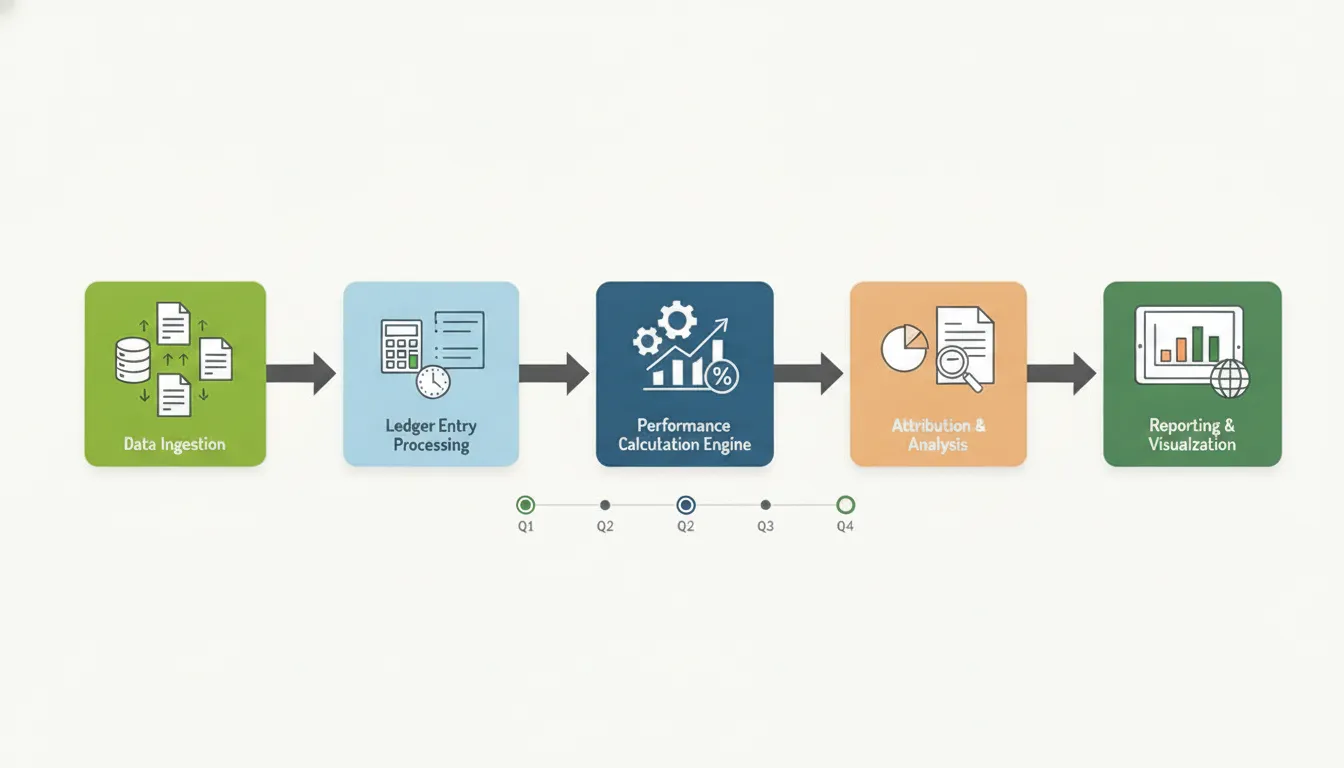
A return percentage is easy to share, but harder to trust without knowing what sits behind it. Which accounts were included? Were fees deducted? How were transfers, distributions, and currency differences treated? A ledger-based investment performance calculation can make those choices visible, provided the underlying records are complete and consistently classified. That matters when finance teams report across companies, partnerships, funds, or accounting platforms. This guide explains how to organize and reconcile ledger data, calculate returns from dated cash flows and valuations, and compare results fairly. You’ll also find practical ways to document assumptions and keep consolidated reports traceable to their source records.
Key Takeaways
- Match the return method to your goal: Use TWR to evaluate investment performance and MWR or IRR to reflect the timing and size of investor cash flows.
- Check ledger data before calculating returns: Reconcile transactions and valuations, apply consistent classifications, and keep supporting records for review.
- [Report consolidated results with clear rules](https://helixreports.com/blog/consolidate-investment-reports-sources): Combine portfolio cash flows and values, then state the measurement period, fee treatment, and return method.
How Do You Calculate Ledger-Based Investment Performance?
Ledger-based performance begins with a reliable record of what happened, when it happened, and how each transaction was classified. Gather dated cash flows, income, fees, and valuations, then choose a return method that matches the question you need to answer. This helps separate investment results from changes caused by adding or withdrawing money.
Calculate returns from dated transactions, cash flows, income, fees, and valuations
Start with the investment’s value at the beginning and end of the period. Include income, such as interest or distributions, and account for costs, including management fees. Record each contribution and withdrawal with its date and amount, since cash invested earlier has more time to affect the result than cash invested later.
A simple return may work when there are no external cash flows during the period. If contributions or withdrawals occur, consider a method that accounts for their timing. The money-weighted rate of return uses dated cash flows and beginning and ending values to reflect the investor’s experience. First, confirm that your ledger contains dependable valuations for the dates used in the calculation.
Separate investment performance from account balance changes
A rising balance does not automatically mean an investment gained value. The balance may have increased because the investor contributed funds, received income, or earned a return. It may have fallen because of a withdrawal, a fee, or an investment loss. Separating these factors makes it easier to understand what drove the change.
To assess investment or manager performance without the effect of external cash flows, calculate returns for each period between contributions and withdrawals, then link those returns. This produces a time-weighted return, or TWR. A money-weighted return, by contrast, reflects the size and timing of cash flows. As Sharesight explains, the two measures answer different questions, so choose based on whether you want to assess investment performance or the investor’s realized experience.
Keep ledger records complete and consistent
Accurate results depend on complete, consistent records. Enter transactions promptly, apply the same categories across periods, and retain statements and valuation support. Make sure contributions, withdrawals, purchases, sales, income, and fees are easy to identify. Standardized record-keeping practices can help reduce omissions and make figures easier to verify.
Before reporting a return, check for missing or duplicate entries and compare opening and closing values with supporting statements. Review how transfers, reinvested income, and accrued income are classified, since inconsistent treatment can affect comparisons. When data comes from multiple accounting systems, a reporting platform such as Helix Reports can standardize information for repeatable reporting while leaving those systems in place.
How Do You Prepare and Validate Ledger Data?
Reliable investment performance calculations begin with complete, consistent ledger data. Before calculating returns, bring records from each investment, account, entity, and accounting system into a structure you can review. Confirm that transactions, income, fees, and valuations are supported by statements or other documentation. Even a correctly applied return formula can produce a misleading result if the ledger contains missing entries, duplicates, or inconsistent classifications.
Set clear rules for recording transaction dates, currencies, investment names, and transaction types. Apply them consistently across reporting periods, and retain source documents so each amount can be traced back to its origin. Recording activity promptly and organizing it by account and date makes it easier to spot errors, as recommended in this guide to maintaining accurate financial records.
When records come from multiple entities or platforms, standardize them before consolidating results. This helps preserve consistent classifications and makes discrepancies easier to investigate. A reporting platform such as Helix Reports can apply metadata-based rules to financial data from connected systems without replacing the accounting platforms already in use. Use the steps below to create a dependable foundation for performance reporting.
Organize records by investment, account, entity, currency, and date
Give each ledger entry enough detail to identify where it belongs. Capture the investment, account, legal entity, transaction date, currency, and a clear description. Include a transaction or reference ID when available. These fields help you trace an amount from a statement or investor report to the correct account and investment.
Use consistent formats for dates, entity names, and currency codes. For example, avoid recording the same entity under multiple spellings, or mixing trade dates and settlement dates without identifying which date you use. Store source files and supporting documents in an organized location, and make sure the ledger points back to them. Records organized by account and date are easier to review and investigate, as explained in this guide to accurate financial record-keeping.
Classify contributions, withdrawals, purchases, sales, and transfers
Assign each transaction a clear type and apply the same classification rules across accounts and reporting periods. Contributions and withdrawals move money into or out of an investment. Purchases and sales change the holdings within an account, while transfers move cash or assets between accounts or entities. Because these categories affect performance calculations differently, consistent labels help prevent cash movements from being mistaken for gains or losses.
Record the transaction date, amount, currency, counterparty, and related investment or account. If an item does not fit a standard category, document how you treated it rather than forcing it into an inaccurate label. Keep confirmations and transfer records with the entry. Quicken’s guide to recording journal transactions also stresses categorizing activity based on its nature.
Record income, reinvestments, and fees consistently
Track dividends, interest, distributions, and other investment income separately from contributions and withdrawals. When income is reinvested, record both the income received and the purchase made with it if your accounting process requires separate entries. This preserves the transaction history and helps ensure the investment’s value and return reflect its activity.
For each fee, record the amount, date, description, and whether it was charged to the investor, account, or investment. Set a consistent policy for gross returns, which exclude specified costs, and net returns, which reflect them. Apply that policy across investments when comparing performance. Transaction costs can affect results, so FINRA’s guidance on evaluating investment performance recommends including fees in the assessment.
Capture opening, closing, and periodic valuations, including accrued income when relevant
Record a documented valuation at the start and end of each measurement period. For investments with infrequent activity or reporting, capture periodic valuations that match your reporting needs and the information available. Note each valuation’s date, currency, method, and source, such as a custodian statement, fund report, or approved internal estimate.
When relevant, include accrued income that has been earned but not yet paid. Apply the same treatment consistently from period to period so results remain comparable. If a valuation is estimated or received after the reporting date, flag it and explain how you handled it. Regular reviews of income, expenses, and performance calculations can help identify inconsistencies. This overview of investment accounting and reconciliation discusses the value of periodic checks.
Reconcile transactions and valuations with statements and supporting records
Compare ledger activity with the statements and documents that support it. Reconcile cash balances, purchases, sales, income, fees, and transfers against bank, custodian, broker, or investment statements. For each valuation, confirm that the ledger reflects an appropriate value for the same date and currency.
Investigate differences instead of adjusting them without an explanation. A variance may reflect a timing difference, such as a trade date versus settlement date, or point to a missing entry or incorrect amount. Document the reason for any adjustment, retain supporting evidence, and note who reviewed it and when. Regular, prompt reconciliation supports financial integrity. General ledger reconciliation guidance recommends completing and reviewing reconciliations consistently.
Check for missing or duplicate entries, corporate actions, inconsistent classifications, and currency differences
Before calculating returns, check for missing statement periods, duplicate transaction IDs, repeated entries, and activity that appears in a source document but not in the ledger. Review corporate actions such as stock splits, mergers, tender offers, and spin-offs. These events can change an investment’s units or value without appearing as a typical purchase or sale.
Confirm that similar transactions use the same classifications across accounts and entities. Keep amounts in their original currency, and document the exchange rate and date used for any conversion. Pay close attention to data imported from different platforms, where date formats, descriptions, and account labels may differ. Standardized processes help reduce omissions and inconsistent records, as noted in these financial record-keeping best practices.
How Do You Calculate Returns From Ledger Transactions?
Ledger transactions provide the detail behind investment activity, but not every entry represents a gain or loss. To calculate a meaningful return, separate changes in investment value and income from contributions and withdrawals. Then choose a method that answers the question you’re asking: time-weighted return (TWR) focuses on investment performance, while money-weighted return (MWR) reflects the timing and size of investor cash flows.
Start by confirming that transactions are dated and classified consistently, and that valuations cover the same reporting period. Check how the ledger treats distributions, reinvested income, fees, and transfers. These details can materially affect a reported result, especially when data comes from several accounts or accounting systems. Keep supporting statements and valuation records available so you can trace the calculation back to its source.
The steps below explain how to account for value changes, cash flows, and costs, and how to choose between common return methods. Apply the same definitions and reporting rules across investments before comparing results. Consistent inputs make it easier to interpret performance and explain differences between account-level and portfolio-level figures.
Include value changes, income, and costs in total return
Total return includes an investment’s change in value and the income it generates, such as interest, dividends, or distributions. It may also account for costs, including management fees and transaction expenses. Be clear about whether you’re reporting a gross return before specified costs or a net return after them.
Use ledger entries to identify income and costs, and valuations to measure changes in investment value. Check for reinvested income: it may appear both as an income transaction and as a purchase, so counting both as separate gains can overstate performance. FINRA’s guidance on evaluating investment performance explains how value changes and income contribute to total return. Apply the same classifications across investments and periods to make comparisons more useful.
Treat contributions and withdrawals as cash flows, not gains or losses
A contribution increases an account balance, but it isn’t investment profit. A withdrawal reduces the balance, but it doesn’t necessarily mean the investment lost value. Classify deposits, capital calls, distributions, and other investor-driven movements as external cash flows, separate from investment income and expenses.
This distinction matters when reviewing ledger activity. A contribution made near the end of a period can raise the closing balance even if the investment performed modestly. A large withdrawal can make the balance fall despite positive performance. The timing and amount of these transactions affect money-weighted results, as explained in Sharesight’s comparison of time- and money-weighted returns. Use clear, consistent transaction labels so the return method can treat each entry correctly.
Use simple return or ROI cautiously when cash flows occur during the period
A simple return or return on investment (ROI) can provide a quick view when there are no significant contributions or withdrawals during the period. It compares the investment’s value at the start and end, with income and costs included according to your reporting rules. But those two values alone may not show how much capital was invested, or for how long, when external cash flows occur.
For example, a late-period contribution can make the ending balance look higher without indicating stronger investment performance. A withdrawal may make it appear lower. If cash flows occurred during the period, use a return method that accounts for their timing rather than treating all capital as though it was invested from the start. FINRA’s overview of investment performance offers useful context for interpreting total and percentage returns.
Calculate time-weighted return between external cash flows
Time-weighted return measures investment performance while reducing the effect of investor-controlled contributions and withdrawals. Divide the reporting period into segments at each external cash-flow date. For each segment, compare the investment’s value at the start and end, accounting for income and costs according to your chosen method. Then link the segment returns to calculate the return for the full period.
TWR is useful when comparing managers or investments across periods with different cash-flow patterns. It depends on reliable valuations around cash-flow dates, not only on beginning- and end-of-period balances. If those valuations are missing, the result may be less precise. Aleta’s explanation of TWR and MWR describes how TWR separates investment performance from cash-flow decisions. Use consistent valuation timing across the periods you compare.
Calculate money-weighted return or IRR from dated cash flows and ending value
Money-weighted return, often reported as internal rate of return (IRR), reflects investment performance alongside the timing and size of cash flows. Gather each dated contribution and withdrawal, then include the ending investment value as the final cash flow. The calculation determines the rate that accounts for those amounts and dates.
Use MWR when you want to understand the return experienced by an investor whose capital entered or left at different times. A contribution made early can affect the result more than one made near the end of the period. This makes MWR useful for assessing an investor’s experience, but it may be less suitable for comparing managers who didn’t control the cash-flow decisions. AnalystPrep’s guide to money-weighted returns explains how dated cash flows and beginning and ending values inform the calculation.
Compare gross and net returns; annualize only when appropriate
Gross return reports performance before specified costs; net return deducts costs such as management fees or transaction expenses. State which costs are included so readers can compare results on a consistent basis. Taxes and inflation may also affect an investor’s experience, but they aren’t always part of a portfolio return figure.
Annualize a return only when the reporting period and calculation method support a meaningful yearly comparison. If the period is shorter than a year, identify the annualization method and avoid presenting the result as though it were a realized annual return. Document the reporting period, valuation dates, fee treatment, and return method alongside the figure. Helix Reports helps teams standardize financial reporting across accounts and systems, making it easier to review performance using consistent source data.
When Should You Use Time-Weighted or Money-Weighted Return?
Time-weighted return (TWR) and money-weighted return (MWR) measure performance from different perspectives. TWR focuses on investment performance, while MWR reflects the effect of cash-flow timing and size on an investor’s results. The right choice depends on the question you’re trying to answer: How did the manager perform, or what return did the investor earn?
For a useful comparison, apply the same return method, measurement period, and fee treatment to each result. If you’re reporting across multiple accounts or entities, calculate the return from consolidated cash flows and valuations rather than combining account-level percentages.
Use time-weighted return (TWR) to assess investment or manager performance
Use TWR when you want to assess an investment or manager without letting the timing of investor contributions and withdrawals affect the result. The calculation separates the measurement period at external cash flows, calculates each subperiod’s return, then links the results. This helps show how the investment performed while reducing the influence of when capital entered or left the account.
TWR is often useful for comparing managers or funds because investors, rather than managers, may control contributions and withdrawals. Aleta’s explanation of TWR describes how the measure separates performance from cash-flow timing. Use it when your focus is investment management, and make sure you have accurate valuations around cash-flow dates.
Use money-weighted return (MWR) or IRR to reflect investor cash-flow timing
Use MWR when you want to understand the return an investor earned on capital actually invested. It accounts for the amount and timing of contributions and withdrawals. MWR is commonly calculated as an internal rate of return (IRR) using dated cash flows and the ending investment value.
Timing can change the result. For example, an investor who contributes more capital before a period of strong returns may have a different MWR from someone who invests the same total amount later. MWR can be helpful for private investments, partnerships, and portfolios with irregular contributions or distributions. Sharesight’s comparison explains how MWR incorporates cash-flow timing, making it useful for assessing an investor’s experience.
Consider who controls contribution and withdrawal timing and amounts
Ask who decides when capital enters or leaves the investment. If investors control contributions and withdrawals while a manager makes investment decisions, TWR can offer a clearer view of the manager’s performance. It reduces the effect of investor cash-flow choices on the reported return.
If you’re evaluating an individual investor’s experience, MWR may be more relevant because it reflects that investor’s actual cash-flow timing. Some partnerships also have sponsors or managers who determine capital calls and distributions. In those cases, be clear about what you’re evaluating: the manager’s investment decisions, or the return realized by the capital providers. The answer helps you choose the measure that fits the report’s purpose.
Compare returns over consistent periods and against relevant benchmarks
Compare returns only when the measurement periods and methods align. Use consistent start and end dates, currency, and fee treatment. A calendar-year TWR and an investor-specific MWR covering different dates answer different questions, so presenting them side by side without explanation can confuse readers.
TWR is often used to compare fund or manager performance with a benchmark because it limits the influence of external cash flows. Starlight Capital’s guide describes TWR as a useful measure for comparing funds and benchmarks. Choose a benchmark with a similar strategy and risk profile, and label the return method and period clearly.
Avoid averaging account returns to estimate consolidated portfolio performance
A simple average of account-level returns can misrepresent a portfolio’s overall performance. It gives the same weight to a small account and a large account, even though they represent different amounts of capital. It can also overlook cash flows between accounts or entities.
Instead, combine dated cash flows and valuations across the accounts, then calculate the return for the consolidated portfolio. For TWR, use total portfolio values around external cash-flow dates before linking subperiod returns. This requires consistent, reconciled data across investments and accounting systems. Helix Reports helps consolidate financial data across systems using standardized reporting rules, supporting more consistent portfolio-level analysis.
How Should You Interpret and Report Returns Across Accounts?
A return figure needs context before it can tell you much. Across multiple accounts, entities, or investment systems, the same percentage can mean different things depending on which investments it covers, how cash flows are treated, and whether fees are included. Differences in valuation dates, currencies, and account classifications can also make results hard to compare. Transfers between accounts you own deserve special attention: at the portfolio level, they are internal movements, not new contributions or withdrawals.
Before calculating returns, define the reporting period, the accounts and investments included, and the return method. Then document your rules for cash flows, fees, taxes, currencies, and valuations. Apply those rules consistently, and keep consolidated figures traceable to the account- and investment-level records behind them. That way, reviewers can follow the calculation and investigate differences without rebuilding the report from scratch.
The practices below can help finance teams produce reports that are consistent and repeatable, especially when data comes from several accounting or investment platforms. They also make it easier to spot issues that manual spreadsheet work can leave hidden.
Aggregate dated cash flows and portfolio valuations before calculating consolidated returns
Bring together dated transactions, cash flows, and portfolio values for every account in scope. Include contributions, withdrawals, income, fees, and investment values at the relevant reporting dates. Identify transfers between accounts you own, too. These are internal movements at the consolidated portfolio level, so don’t treat them as external contributions or withdrawals.
Account-level return figures may not contain enough information to calculate the portfolio’s overall time-weighted return. You may also need the portfolio’s total value when an external cash flow occurs. The Financial Wisdom Forum discussion explains why account returns can’t always be combined directly. Keep the dated source records with your calculation so you can show how each account and investment contributes to the consolidated result.
Use total portfolio values on cash-flow dates for accurate TWR calculations
Time-weighted return, or TWR, measures investment performance while reducing the effect of external deposits and withdrawals. To calculate it across accounts, divide the reporting period into subperiods at each external cash-flow date. Use the total value of all included accounts at each date, applying a consistent method to determine whether the valuation is before or after the cash flow.
Calculate a return for each subperiod, then link those returns to find the period’s TWR. If account values come from different dates, or an account is omitted when money moves, the result may not represent the full portfolio. Amerisave’s guide to rate of return explains how TWR accounts for external cash flows. Document the valuation source and timing, especially when an exact cash-flow-date value isn’t available.
Reconcile consolidated results with account- and investment-level records
Compare the consolidated calculation with the records that support it. Check transactions against account or custodian statements, and confirm that income, expenses, purchases, sales, and corporate actions appear in the correct period. Then compare account and investment values with their source records. A difference could point to a missing transaction, an outdated valuation, a timing mismatch, or an incorrect classification.
Make reconciliation a regular part of reporting, not just a year-end task. Frequent checks help you investigate discrepancies while supporting records are easy to find. Financial Planning Strategies’ overview of investment accounting highlights statement comparisons, income and expense verification, and performance validation as recurring activities. Record unresolved differences, their likely causes, and any effect on reported returns. This gives reviewers useful context and helps the team follow up consistently.
Clarify how fees, taxes, and inflation affect reported returns
Label each return as gross or net of fees, and state which costs you include. A gross return can help assess investment performance before specified costs; a net return shows results after those costs. Transaction fees, advisory charges, fund expenses, and account fees may be handled differently, so describe your approach rather than relying on the label alone.
Taxes depend on an investor’s circumstances and may not be part of a standard performance figure. Inflation-adjusted returns can show changes in purchasing power, but should be identified separately from nominal returns. FINRA’s guidance on evaluating investment performance notes that transaction fees matter when assessing results. In each report, name the return measure, the period, and the costs or adjustments included. This makes comparisons more useful and helps prevent readers from drawing conclusions from percentages without enough context.
Apply consistent rules for valuation timing, currencies, accrued income, and corporate actions
Set clear rules for valuation dates, exchange rates, and accrued income. A portfolio valued at month-end may not be comparable with one valued on a different schedule. For accounts held in different currencies, specify the exchange-rate source and conversion date. Decide whether accrued interest and dividends are included in investment values or recorded separately, then apply that treatment consistently.
Document how you handle corporate actions, such as stock splits, mergers, and distributions, so holdings and values are updated in the right period. Anne Napolitano Consulting’s record-keeping guidance emphasizes consistent processes for accurate records. If you change a rule, record when it takes effect and consider whether prior periods need to be restated for a fair comparison. Consistent policies make consolidated results easier to review and explain.
Weigh ledger tools’ flexibility against manual-entry, formula, and data-quality risks
A ledger lets you choose how to classify transactions and calculate performance, which can be useful when standard templates don’t fit your investments or account structure. But manual entry can lead to omissions, duplicates, incorrect dates, or inconsistent labels. Spreadsheet formulas bring another risk: someone can overwrite a calculation or apply a different method in the next reporting period.
If you rely on a ledger or spreadsheet, document the calculation method, protect key formulas, and review changes before finalizing reports. Import transaction data where possible, then compare it with statements and other source records. Quicken’s guide to recording transactions describes how accounting software can streamline transaction recording. Software can reduce repetitive work, but it can’t correct incomplete or misclassified source data on its own.
Use spreadsheets for simple tracking and reporting platforms to standardize data across systems
A spreadsheet can be practical for a small portfolio with a few accounts and straightforward cash flows. It’s adaptable, and you can inspect how each calculation works. As the number of investments, entities, or source systems grows, maintaining separate files and formulas can make consistent reporting harder. Repeated imports, version-control issues, and mismatched account labels all add review work.
A reporting platform may suit teams that need a standardized view across several systems. Helix Reports’ explanation of how its platform works describes a metadata-based approach to consolidating data while preserving reporting rules and supporting data checks. When evaluating tools, check which systems they connect to, whether they support your reporting needs, and how easily you can trace results to source records. Choose a process that makes reporting repeatable, not simply one that replaces a spreadsheet with software.
Make calculations repeatable with validation checks, reconciliations, and an audit trail
Build validation into each reporting cycle. Check that opening values, transactions, cash flows, and closing values reconcile for every account. Look for missing or duplicate entries, unexpected currency changes, and totals that differ from statements. Compare returns with prior periods and investigate unusual movements before sharing the report.
Keep an audit trail of source files, calculation rules, data changes, review dates, and approvals. This lets another reviewer understand how the report was prepared and reproduce the result later. Quicken’s transaction-recording guidance recommends regular reviews to check that entries are complete and consistent. Pair those reviews with documented reconciliations and clear ownership for resolving exceptions. When data comes from several accounts or platforms, these steps make it easier to verify the reported performance and explain how you arrived at it.
Related Articles
- Investment Reporting Software for Multiple Platforms: Best Options Compared | Helix Reports
- How to Consolidate Investment Reports From Different Sources | Helix Reports
- Financial Reconciliation: Types, Steps, and Best Practices | Helix Reports
- How to Standardize Financial Reporting: 10 Steps | Helix Reports
- General Ledger Accounting: The Complete Guide | Helix Reports
Frequently Asked Questions
What records do I need to calculate investment returns from a ledger?\ Gather dated transactions, including contributions, withdrawals, purchases, sales, income, and fees, along with opening, closing, and any required interim valuations. Keep statements or other supporting documents so you can verify entries and explain how each figure was determined.
Which return method should I use for a portfolio with irregular cash flows?\ Use time-weighted return (TWR) when you want to assess investment performance with less influence from the timing of investor cash flows. Use money-weighted return (MWR), often calculated as IRR, when you want to understand how the timing and size of cash flows affected an investor’s experience.
How should I treat transfers between accounts in a consolidated portfolio?\ Treat a transfer between accounts included in the same portfolio as an internal movement, not as an outside contribution or withdrawal. This helps prevent the transfer from being mistaken for a change in investment performance.
Should I report returns before or after fees?\ Either can be useful, but label the result clearly. A gross return excludes the costs specified in your reporting policy, while a net return reflects those costs. Apply the same treatment across the investments you compare.
Can I combine account-level returns to calculate a portfolio return?\ A simple average of account returns may misstate the portfolio result because accounts can represent different amounts of capital and have different cash-flow timing. For a consolidated return, combine the underlying dated cash flows and valuations, then calculate the return for the full portfolio.